This article is about classifying things. It’s inspired by the fact that there are leaf-shaped swords and sword-shaped leaves, but also swords that aren’t leaf-shaped and leaves that aren’t sword-shaped. So, when we say a sword is leaf-shaped, which kind of leaves is it like? Similarly, when a leaf is sword-shaped, what kind of sword is it like? I’ll get into other kinds of classification, to show the messy details that seem intrinsic to many things that people make.
Classifying or naming?
This is a big and complicated subject that I’m not an expert in, so I want to define some boundaries first to define what I’m not talking about. I think it’s helpful to separate out two problems – classifying and naming. As an example of this difference, look at the periodic table of elements, where there are hundreds of things – hydrogen, carbon, iron, plutonium etc.
I don’t think that deciding if something is hydrogen or helium is a classification problem. Once you’ve decided to separate atoms by the number of protons they have, then things become much simpler – there are 1-proton atoms, 2-proton atoms and so on.
There is a remaining problem, which is what you call an atom with 1 proton, or an atom with 2 protons. We call a 1-proton atom hydrogen, a 2-proton atom helium etc. (I realise that the order of things was the other way around – the names hydrogen and helium came first, and then we later discovered how many protons they had – but I think my point still holds.)
For me, classification involves imposing an arbitrary structure on something, not just an arbitrary set of names. There must be a set of dividing lines whose position was chosen, where the position could be different but seems to make most sense where it is.
In the case of atoms we decided to:
- Distinguish things by the number of protons
- Treat each value as a new thing, rather than saying that 1-4 protons is thing A, 5-7 protons is thing B etc.
The second point is the key one – we start with the set of natural numbers (1, 2, 3, etc.) laid out on a number line and we don’t group them. Having a number-based thing isn’t enough for it to be classification – we need to add boundaries in a way that’s more arbitrary than between each thing and the next.
Swords
We’ll now come to swords. Before we go into the details, it’s important to do a bit more definition. Specifically: what’s a sword? Some things are fairly obviously swords, but it gets blurry around the edges.
Is a machete a sword? What’s the difference between a (long) knife and a (short) sword? It gets messier when you look at something like a messer. From a distance it looks like a sword, but the handle is made in a knife-like way – the tang (the continuation of the blade into the handle) is sandwiched between two layers of wood or similar, and you can see all three from the side. The name is even the German word for knife, so messerschmidt is knife smith a.k.a. cutler – someone who makes cutlery including knives.
Is it defined by how it’s used, and by whom? In The Hobbit, Bilbo Baggins wields a weapon called Sting. It’s actually an Elven dagger but for him, given his hobbit size, it’s a sword. I don’t know how to draw a clear line that includes all swords and excludes everything that’s not a sword so I’ll leave it as an open question for you to think about. (When you’ve finished with that, you might want to consider another question: What’s classical music?)
Due to friends who have swords and friends who make swords, I’ve come across the Oakeshott typology for swords. It’s important to note that it doesn’t try to classify all swords. It’s for European double-edged swords from roughly the 11th to 16th centuries, and builds on the Petersen typology of Viking swords. It defines 13 types of sword, labelled X to XXII, mostly based on the blade’s shape and size. The blade’s length, taper, cross-section and pattern of fullers (grooves in the surface) together define the type. The hilt can vary within a type.
This is an approach to classification that’s similar to (UK) dress sizes. Just as a particular type of sword defines many characteristics (blade taper, cross-section etc.), as a particular dress size defines more than one characteristic (bust, waist and hip sizes). This approach has some strengths and weaknesses.
A strength is it’s concise – a size 12 dress, a type XX sword. One weakness is due to how strongly related the different characteristics are. If you imagine putting each characteristic on its own axis in a scatterplot, e.g. bust size as the x axis, waist size as y and hip size as z, you could then plot all the examples of the thing you’re trying to classify. In the case of dresses it’s important to remember that you’re actually classifying people, and then the dress classifications need to go where the people are.
You then look at the distribution of dots on this scatterplot and try to make sense of it. Do the dots fall into obvious clusters? Another way of putting it is: how strongly related are the characteristics? Do people with a certain bust size often have a size waist and hip size? Do swords with greater taper also have short fullers?
If things are tightly clustered, then the classification will work well. However, life is often messy, and the groups can often be fuzzy around the edges, spread out, merge into each other etc. How well does the classification have to work before it’s a good idea to use? Who makes that decision? Who benefits and suffers? For instance, what about people with “non-standard” body shapes?
There’s another potential issue with this cluster-based approach, which the Oakeshott sword typology has but UK dress sizes don’t. Assuming you have divided things up into clusters of similar things, what do you call the clusters? In UK dress sizes, the cluster (dress size) is a number, which is derived from one of the characteristics (dress size = bust size in inches minus 24). However, why are sword types labelled in the order they are? Why is type X called type X and not type XXII? Is there an obvious order to the clusters of thing, or is arbitrary? Is one cluster deemed better than the others – if so, why?
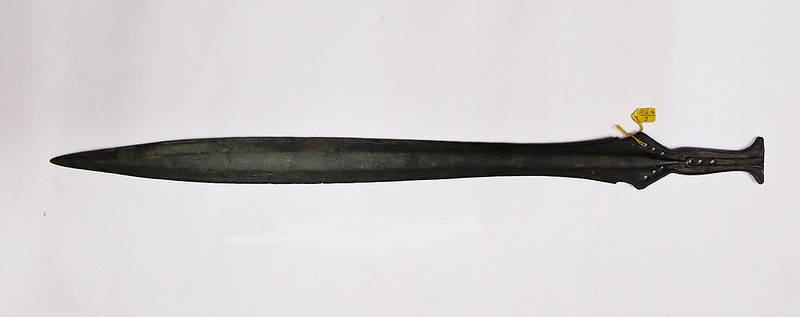
So, with all this out of the way, what about leaf-shaped swords? There are examples of leaf-shaped swords from the UK and Greece. I can’t find it in any sword typologies – Oakeshott covers swords from later in history, and the Elmslie typology covers single-edged swords.
This highlights a point about classification – the set of things they can classify is important, not always obvious and sometimes forgotten. Oakeshott and Elmslie don’t try to classify all swords, just swords from a particular part of the world and period in history. The fact that there are swords outside their scope doesn’t necessarily mean they’re bad. The bigger the set of things that we try to classify, the less likely things are likely to fall into neat clusters, or the more complex the classification system has to become (see below).
Leaves
Leaf shape is classified in a different way to the Oakeshott typology and dress sizes. Instead of grouping many characteristics together into one category there are many categories in parallel, each one for a different characteristic.
Starting with the big picture and then zooming in there are separate categories for:
- Leaf structure – e.g. simple, ternate (with three leaflets, like clover), palmate (like a sycamore)
- Leaf / leaflet shape – e.g. cordate, elliptic, ensiform, lanceolate
- Edge – e.g. entire, ciliate (fringed with hairs), crenate, dentate, serrate, sinuate
This is similar to ordering a coffee in a coffee chain. Instead of asking for a type 14 coffee, you could ask for a Venti Iced Caramel Macchiato with almond milk and an extra shot of espresso. (Or you could do as I do, and order tea.)
The more clusters of values a characteristic has, and the more characteristics together define a thing, the more things multiply up into an unmanageable number of clusters if you try to have e.g. a type 24 leaf. The classification stops being something you can easily remember, and would have to look up each time and risk getting wrong.
It’s interesting to me that the term for sword-shaped is ensiform. It comes from the Latin word ensis – a classical or poetic term for sword. I was expecting it to be something like gladioform, from gladius. This is the word that gives rise to gladiator and the flower gladiolus, which has sword-shaped (remember: ensiform) leaves. (There’s also the word spatha, which is a sword that’s often longer than a gladius.)
So, if a leaf-shaped sword were classified using leaf terms, it would be:
- Simple – one big leaf, not like clover or sycamore
- Lanceolate – like a lance tip, which goes out and in again, not ensiform which is a non-leaf-shaped sword blade
- Entire – no frilly edges
I have seen swords whose edge would be something other than entire, such as a flambard blade that would be sinuate or maybe undulate.
Why classify?
Given the limitations and complications of classifying things, why bother? Classification is such a fundamental activity, deeply part of philosophy, science and everyday life, that we might not think why we do it. I’m neither a philosopher nor a scientist, but here are my thoughts.
Classification simplifies things, and so reduces the number of things we need to think about. Instead of the thousands of different swords in collections around the world, we can think about the tens of different types of sword. It also filters away detail – instead of thinking about the material used in sword’s hilt, how much the hilt is ornamented etc, the Oakeshott typology looks at just the blade.
Once we have less to think about, it can be easier to see the wood for the trees. It’s easier to see similarities and differences between categories. A category acts in a similar way to an average in statistics – one bit of information that stands for a set of things. A handful of averages is usually easier to work with than the underlying raw data.
If two people agree on a classification, that can help them communicate. If we both know Oakeshott’s typology, you can be confident what kind of sword I’m trying to sell to you (at least, in term of its blade shape and size).
However, like with statistics, sometimes we forget the limitations of classification. Sometimes the detail and variation that have been thrown away are important. The average salary of a group of people might be £50,000, but behind that average might be someone on only £16,000 (hidden because there are enough people above £50,000). Someone whose body is somewhere between a size 12 and a size 14 might wish for the existence of things like a size 13 so that they can have clothes that fit them better.
A classification can stray into a stereotype. For instance, we classify someone by their accent, and think that this is also an indicator of their intelligence, honesty, kindness etc. We also use classification to define good and bad – an in-group (us and people like us) and an out-group (everyone else).

